What is Zild?
Zild is an AI Agent Management Platform (AMP): the operating layer that connects AI agents to models, business context, channels, actions, and governance.
Zild is an AI Agent Management Platform (AMP): the operating layer that connects AI agents to models, business context, channels, actions, and governance.
What is an AMP?
At Zild, AMP means AI Agent Management Platform. It is the control plane used to build, run, supervise, and improve AI agents in a real business operation. An AMP is not an AI model and it is not another chat interface: it is the layer that determines which model an agent may use, what context it receives, which actions it can take, where it can interact, and how every result remains traceable.
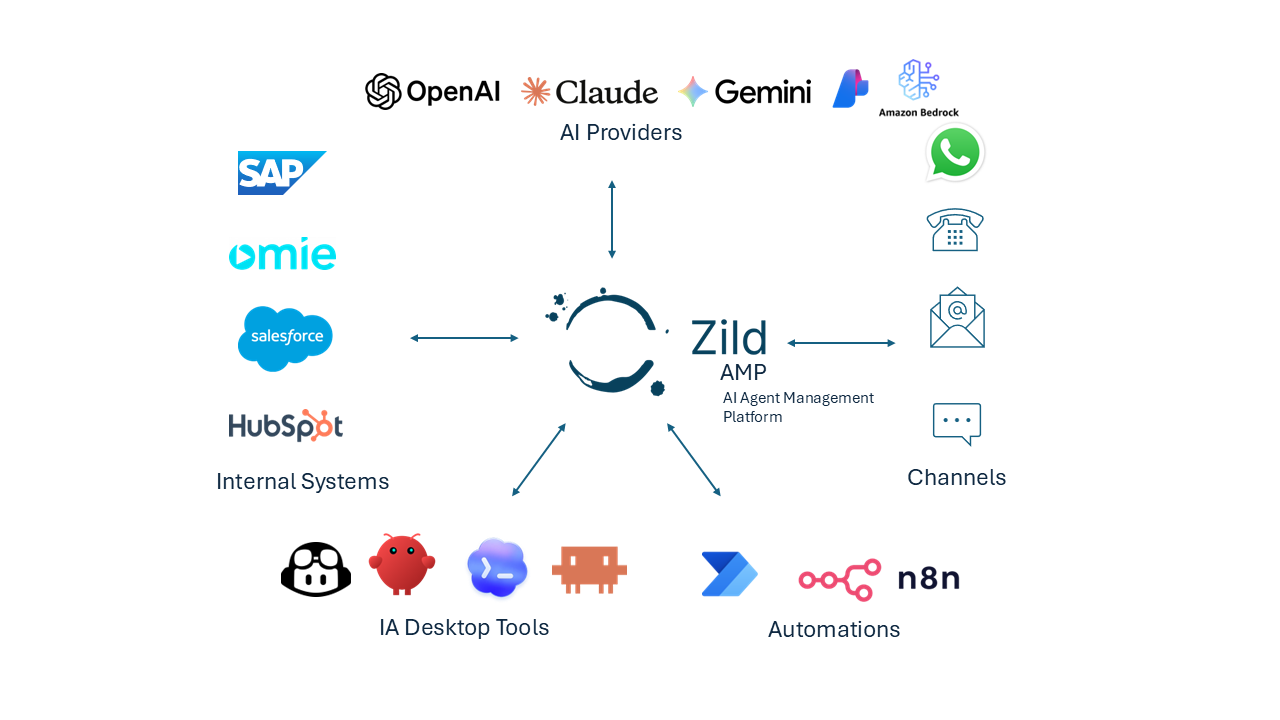
More than a bot
A bot usually solves one conversation or one task. An AMP coordinates the operating model for many agents and use cases. Providers can change without rewriting the business process; channels share the same instructions and knowledge; permissions and human handoff remain consistent; and evidence feeds monitoring and continuous improvement.
What Zild coordinates
| Boundary | What the AMP manages |
|---|---|
| AI providers | Approved language, voice, vision, and multimodal models, with routing and provider independence. |
| Systems and knowledge | CRM, ERP, support platforms, documents, databases, APIs, and trusted business context. |
| Channels | WhatsApp, voice, webchat, email, Microsoft Teams, documents, and other interaction surfaces. |
| Actions and automation | Tools, workflows, webhooks, desktop agents, tasks, approvals, and human handoff. |
| Control and evidence | Identity, permissions, guardrails, histories, evaluations, metrics, and audit trails. |
Why this layer needs to exist
AI prototypes are easy to isolate; production operations are not. Without a management layer, prompts, credentials, integrations, policies, and conversation histories become scattered across vendors and teams. The AMP provides one governed foundation, allowing the company to start with a single workflow and add new agents, channels, and providers without rebuilding control every time.
The result is not simply an agent that answers. It is an operation that can act within limits, involve a person when needed, retain evidence, and improve from what happened.
How an AMP works
- Discover and register: maintain an inventory of agents, owners, versions, purposes, environments, models, data sources, tools, and risk classifications — including agents built outside the platform.
- Authorize: authenticate the user and the agent, resolve tenant and role context, and determine which data, model, channel, tool, and action are allowed.
- Orchestrate: supply approved context, route each request to the appropriate model or workflow, execute tools, coordinate agent-to-agent interactions, and request human approval when required.
- Inspect at runtime: validate inputs, outputs, tool calls, cost, latency, policy compliance, and anomalous behavior while the agent is operating.
- Retain evidence and improve: record lineage, decisions, outcomes, cost, evaluations, and interventions so teams can audit the operation and safely publish a new version.
Gartner describes AMPs as centralized platforms for managing custom-built and marketplace agents across deployment environments, with a unified view of cost, ROI, governance, and security. In practice, the AMP becomes the control plane above models and agent frameworks, rather than another isolated agent builder.
AI FinOps: connect consumption to value
AI FinOps applies financial accountability to AI consumption. In an AMP, metering does not stop at the provider invoice. The platform attributes tokens, inference, voice minutes, storage, searches, tool and API calls, retries, infrastructure, and human handoffs to a tenant, agent, workflow, and business outcome.
| Capability | How it operates in the AMP |
|---|---|
| Allocation | Break down consumption by business unit, customer, agent, channel, provider, model, and use case. |
| Unit economics | Calculate cost per interaction, completed task, resolved case, qualified lead, document, or autonomous decision. |
| Control | Apply budgets, quotas, alerts, anomaly detection, and approval thresholds before excess consumption becomes an invoice. |
| Optimization | Route work to the model that meets quality, latency, risk, and cost requirements; reduce unnecessary context, retries, and tool calls. |
| Value | Compare cost with resolution, revenue, productivity, quality, and risk outcomes instead of optimizing tokens in isolation. |
Gartner uses the idea of agentic FinOps and tokenomics to express the unit economics of autonomous decisions. The central question is therefore not “which model is cheaper?”, but “what did this agent cost to produce a valid business outcome, and was that outcome worth it?”.
ModelOps: manage the model lifecycle
ModelOps governs models from evaluation and approval through production, monitoring, replacement, and retirement. The AMP keeps a catalog of approved models and capabilities, records which agents use each model, controls version promotion, and monitors quality, latency, availability, drift, safety, and cost.
For agentic systems, the release unit is broader than the model. An agent version can also include instructions, prompts, knowledge and RAG configuration, tools, permissions, evaluation sets, fallback rules, and human escalation behavior. The AMP links these artifacts so a change can be tested, approved, released gradually, compared with the previous version, and rolled back with evidence.
An AMP does not replace data science training pipelines or MLOps infrastructure. It consumes their approved artifacts and adds the operational context required to know which agents may use them, under which policies, and with what result.
Security: protect identity, data, and action
| Control | How it operates |
|---|---|
| Agent identity | Give every agent and service a verifiable identity, owner, tenant, and lifecycle state; do not treat an API key as the agent's identity. |
| Least privilege | Authorize data, tools, MCP servers, APIs, channels, and agent-to-agent communication by scope and context. |
| Data protection | Classify and minimize context, mask sensitive values, apply DLP, protect secrets, and limit retention and provider exposure. |
| Runtime inspection | Detect prompt injection, data exfiltration, unsafe output, unusual tool sequences, privilege escalation, and policy evasion. |
| Action containment | Use allowlists, transaction limits, approvals, sandboxing, timeouts, circuit breakers, human handoff, and a kill switch. |
| Investigation | Preserve prompts, context lineage, model and tool calls, policy decisions, outputs, and interventions in a tamper-resistant audit trail. |
Security must therefore cover the entire path — user to agent, agent to model, agent to data, agent to tool, and agent to agent — not only the model endpoint.
Governance: policies enforced continuously
Governance defines purpose, ownership, decision rights, acceptable use, risk classification, data policy, quality criteria, approval requirements, and accountability. The AMP translates those decisions into technical controls that operate before deployment and during every execution.
This follows the direction of Gartner's AI TRiSM guidance: policies alone state intent, but operational governance requires inventory, traceability, continuous assurance, runtime inspection, and enforcement. An agent may be approved for one process and prohibited from another; a low-risk response may run automatically while a payment, data change, or sensitive disclosure requires human approval.
Governance also continues after go-live. Evaluations, incidents, overrides, cost anomalies, model changes, and user feedback can trigger review, restrict an agent, return it to testing, or require a new approval. Central policies can coexist with delegated business ownership, creating a federated model with common evidence and controls.
How the four disciplines work together
FinOps answers whether the agent is economically viable. ModelOps verifies that its models and release artifacts remain fit for purpose. Security restricts who and what the agent can access or change. Governance defines why the agent exists, who is accountable, and which evidence proves compliance.
The AMP joins these views around the same execution. A cheaper model is not selected if it violates quality or risk policy; a high-performing model is not released without approval; an authorized tool is not called outside its transaction limit; and a successful task is not considered complete if its cost or evidence cannot be attributed. This is what turns a collection of agents into a manageable agentic workforce.
Observability and evaluation
An AMP must show not only whether an agent is online, but whether it is producing the expected result. Observability connects each execution to traces, model and tool calls, retrieved context, policy decisions, latency, cost, errors, human interventions, and the final business outcome.
| View | Examples |
|---|---|
| Technical health | Availability, latency, timeouts, provider errors, retries, token usage, and tool-call failures. |
| Agent behavior | Task success, instruction adherence, groundedness, hallucination, unsafe output, and correct tool selection. |
| Operational performance | Resolution rate, handoff, rework, processing time, backlog, and SLA or SLO compliance. |
| Business impact | Qualified leads, revenue, productivity, quality, customer satisfaction, loss prevention, and risk reduction. |
Evaluation combines deterministic checks, curated test cases, model-based evaluation, human review, and production feedback. Thresholds can block a release, trigger an alert, reduce autonomy, route traffic to a fallback, or return an agent to testing.
Agent lifecycle
- Register: document purpose, owner, users, channels, data, tools, expected outcomes, and initial risk classification.
- Build: configure instructions, knowledge, models, tools, limits, escalation, and evaluation cases in an isolated environment.
- Validate: run functional, security, quality, cost, and policy tests, including edge cases and adversarial scenarios.
- Approve and release: collect required sign-offs, freeze a traceable version, and deploy gradually by environment, audience, or traffic percentage.
- Operate: monitor outcomes, incidents, spend, drift, feedback, and human interventions against defined objectives.
- Change or roll back: compare versions, preserve evidence, publish controlled changes, and quickly restore the last approved version.
- Retire: disable identities and credentials, remove access, preserve required records, and communicate the replacement or end of service.
The AMP keeps this lifecycle consistent even when agents were created with different frameworks or run in different clouds.
Identity, ownership, and accountability
Every production agent should have a unique identity and an accountable human owner. Its registry must state who sponsors it, who operates it, who approves risk, who responds to incidents, which business purpose it serves, and when its authorization must be reviewed.
The agent identity is used in authentication, authorization, audit, and revocation. This prevents shared credentials from hiding which agent performed an action. Responsibility remains human: an autonomous execution does not remove the decision rights and accountability of the people and business area that approved the agent.
Interoperability and provider independence
An AMP sits above a heterogeneous ecosystem. It can standardize access to models, APIs, data, tools, MCP servers, events, channels, and agent-to-agent communication while preserving provider-specific capabilities behind controlled adapters and gateways.
Interoperability requires contracts for identity, permissions, discovery, schema, timeouts, retries, idempotency, lineage, and error handling. MCP can expose tools and context; agent-to-agent protocols can delegate work; APIs and events connect enterprise systems. The AMP applies the same policy and evidence requirements across these paths.
Provider independence does not mean every model or framework is interchangeable. It means business processes, controls, and evidence are not inseparably embedded in one provider. Changes can then be evaluated and introduced without rebuilding the operating model.
Human-in-the-loop and levels of autonomy
| Mode | When to use |
|---|---|
| Human executes | The agent prepares analysis or a draft, but a person performs the action. |
| Human approves | The agent proposes an action and waits for explicit approval before execution. |
| Human supervises | The agent acts within limits while people monitor exceptions, samples, and alerts. |
| Autonomous within policy | The agent completes low-risk, reversible work inside predefined scope, budget, and confidence limits. |
Autonomy should be assigned per action, not as one label for the entire agent. A service agent may answer a FAQ automatically, require approval to grant a refund, and be prohibited from changing an identity record. Handoff must preserve context, evidence, reason for escalation, and a clear path for the person to resume the work.
AMP compared with adjacent platforms
| Category | Primary responsibility | How it relates to an AMP |
|---|---|---|
| Agent builder or framework | Create an agent, its prompts, tools, and reasoning flow. | The AMP can govern agents built with several builders and frameworks. |
| MLOps and ModelOps | Develop, release, monitor, and govern models and analytical assets. | The AMP consumes approved models and relates them to agents, actions, policies, and business outcomes. |
| iPaaS and workflow automation | Integrate applications and orchestrate deterministic processes. | The AMP uses these flows as tools or execution paths and adds agent identity, evaluation, autonomy, and behavioral control. |
| API management | Publish, secure, limit, and observe APIs. | The AMP uses API controls and adds context about agents, models, tools, decisions, and agent-to-agent interactions. |
| AI governance platform | Define and enforce responsible-AI policies across the enterprise. | Governance is a core AMP capability; broader governance platforms may cover AI systems beyond agents. |
| AMP | Manage the economic, behavioral, security, and operational accountability of agents at scale. | Unifies inventory, lifecycle, runtime control, evidence, cost, and outcomes across the agentic workforce. |
Measure business outcomes
Agent metrics must connect technical activity to the process the agent was introduced to improve. A useful scorecard combines outcome, quality, speed, cost, risk, and human effort. Examples include cost per resolution, first-contact resolution, conversion, revenue influenced, processing time, document accuracy, rework, SLA compliance, human minutes saved, escalation quality, and prevented incidents.
Each metric needs a baseline, target, owner, measurement window, and source of evidence. Token volume or number of conversations alone does not prove value. The AMP should make it possible to compare the result with the previous process and identify when apparent productivity is offset by corrections, risk, or poor customer experience.
A practical maturity model
| Stage | Characteristics | Next step |
|---|---|---|
| 1. Isolated agent | One use case, local credentials, manual tests, limited ownership and cost visibility. | Register the agent, owner, purpose, access, baseline, and risks. |
| 2. Monitored operation | Production traces, evaluations, cost allocation, defined handoff, and incident response. | Standardize lifecycle, release gates, identity, and runtime controls. |
| 3. Centralized governance | Shared inventory, policies, approvals, evidence, security controls, and multi-provider management. | Delegate ownership through a federated model and optimize across the portfolio. |
| 4. Managed agentic workforce | Agents collaborate across processes with unit economics, behavioral oversight, dynamic routing, and continuous assurance. | Continuously rebalance value, autonomy, risk, and human capacity. |
Limits and responsibilities
- Centralization improves visibility and control, but it does not make an unsafe process safe by itself.
- Guardrails reduce risk but cannot guarantee that probabilistic systems will always produce correct or appropriate outcomes.
- An AMP does not replace data quality, process design, cybersecurity, privacy, legal review, or accountable business ownership.
- Human review is still required for high-impact, irreversible, ambiguous, regulated, or exceptional decisions.
- Provider independence has practical limits: models differ in capability, data treatment, latency, price, and supported tools.
- Logs and evidence also contain risk and must follow access, minimization, retention, and privacy policies.
- More autonomy should be earned through measured performance and can be reduced when risk, drift, or uncertainty increases.